
Scott here! Surprise! We had a travel day today. We didn’t go far. Technically, we left mooring ball #24 and moved to mooring ball #55. Our preferred ball #63 was taken. It just took us about 16 miles to get that 1/4 mile!
Yesterday we took delivery of our Blackwater Bazooka from Captain Dan and Last Call’s owner Alec. Thank you to you two so much. Today was really the first day I didn’t have a lot of stress and was able to really relax and enjoy the ride.
The wind was between 11-15 mph and the waves were forecasted at 2′ with 1′ swells with long periods between each. I think the waves were between 2-4′ with a shorter period between them, but this needed to be done.
We left the mooring ball at 7:30 am and left to go to sea, or Exuma Sound. Once we were a little more than 1 mile out I started prepping everything and at 3 miles we started the process.
The Blackwater Bazooka worked as advertised and I am extremely pleased with the product and service from the owner/creator John. You can see his products here.
Needless to say our black tank is empty and we don’t need to be so conservative in our use. I embedded a short YouTube video I made on the process below.
Initial Plan
Date: January 2, 2024
Nebo Link: Click here
Spot Link: Click here
Crew: Captain Scott, 1st Mate Rita, & K9 Jazzy
Start at: xx:00 am
End at: xx:00 pm
Total Time: xx hours (xx travel time plus time to dock)
Distance: xx miles
Hazards for the day
Watch for shallow water
If you are curious about blackwater discharge in the ocean. It is legal and accepted practice. The below information is from Blackwater | Sailors for the Sea.
Under US federal law, it is illegal to dump raw, untreated sewage into navigable U.S. waters, including coastal waters within 3 miles of shore and inland waters (lakes, reservoirs, rivers, etc.). A No Discharge Zone (NDZ) takes this law a step further and prohibits the discharge of both treated and untreated sewage into a designated body of water.
A NDZ is created if a state determines that a body of water either:
- Requires greater environmental protection and there are adequate pumpout facilities available.
- Has particular environmental importance (e.g. sensitive areas such as shellfish beds or coral reefs).
- Or has drinking water intake zones
I could only find NDZ information on charts for the Bahamas. It is obvious areas that are NDZ. It seems perfectly legal out in deep water. A note, a pump-out boat will be starting in Elizabeth Harbor around January 15, so we will use that if we are still here.
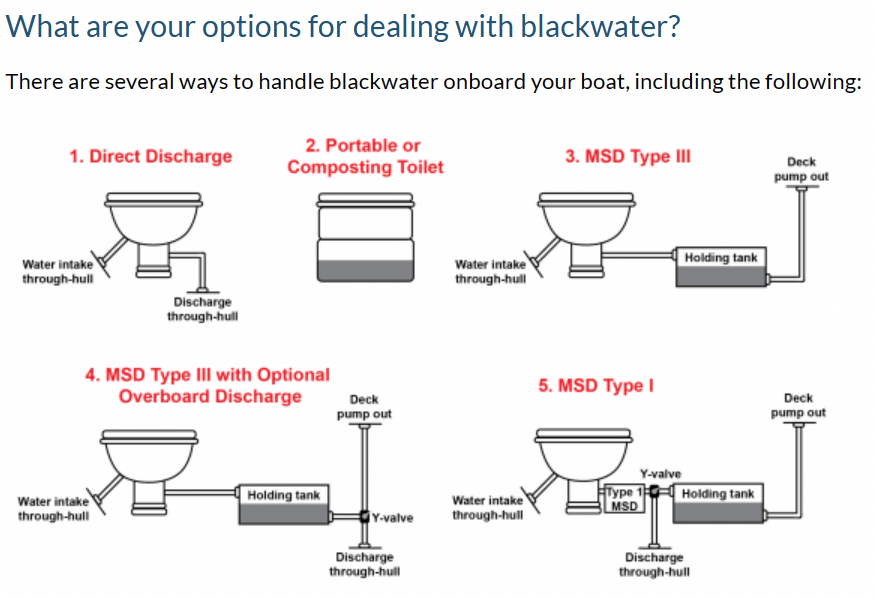
1. Direct Discharge: If you are boating in locations that do not have waste pumpout facilities, try to discharge your waste overboard while underway in deep water away from beaches and anchorage sites. Pumping out your waste near shore is harmful to swimmers, snorkelers, divers, other recreational users, and those who eat the local fish and shellfish.
2. Portable or Composting Toilet: They don’t require installed water, power or holding tank, and are great for weekend trips. Check out Nature’s Head and Air Head Dry Toilet for composting options.
3. MSD Type III: For regions with adequate pumpout facilities, a holding tank connected between your head’s discharge and a through-deck pumpout fitting is simple, inexpensive to install and meets the requirements of the law.
4. MSD Type III with Optional Overboard Discharge: In addition to the deck pumpout fitting, a Y-valve can be placed after the holding tank, so sewage can be directly dumped overboard beyond the three-mile limit, if based in the US. Y-valve must be secured in the off position to prevent accidental discharge of untreated sewage.
5. MSD Type I: All of the waste is treated by maceration or chlorination before entering the holding tank or being directly dumped overboard. Offshore recreational boats generally use this type of MSD.
*There is a MSD Type II, which treats sewage through aerobic digestion. However, it is generally found on large commercial vessels.
 Surf & Turf Retirement Adventures